Power moves: In April, Palo Alto bought Protect AI, a leader in securing the use of AI and machine learning applications and models. But perhaps its biggest move to date involves CyberArk, which in July the company agreed to buy for $25B, tackling the identity management space it has long avoided.
By the numbers: $25B and $9B: In addition to the hefty price the company is paying for CyberArk, Palo Alto Networks is also predicting that fiscal 2025 total revenue will reach between $9.17B and $9.19B, representing year-over-year growth of 14%.
Outlook: Palo Alto Networks has been successful in providing an integrated security platform that addresses the issues of complexity and integration. Palo Alto’s numbers have been going through the roof — first quarter revenue grew 15% and next-gen security grew at an annual run rate of 34%.CEO Nikesh Arora said, “In Q3, we continued to make progress on our platformization strategy and achieved an important milestone in crossing $5 billion in Next-Gen Security ARR. Our scale and platform breadth makes us a leading consolidator of choice in cybersecurity.” How it will incorporate CyberArk’s technology remains to be seen, but effective intregration of identity management could prove to be “a great story,” according to Sunil Varkey, advisor at Beagle Security.
2. Microsoft: All in on agentic AI
Why they’re here: With a pipeline into OpenAI’s innovative technologies, its own public cloud (Azure), and deep hooks into enterprise customers, Microsoft is well positioned to deliver seamlessly integrated security products. The company has built out a platform that includes Microsoft Defender for cloud workload, endpoint, and Office 365 protection; Sentinel for threat intelligence and analytics; Entra ID for identity and access management; and Purview for data security and governance. Microsoft is also a leader in delivering AI-powered agents through its Microsoft Security Copilot offerings
Power moves: Microsoft has announced several new agentic security solutions, including a phishing triage agent, an alert triage agent, a vulnerability remediation agent, a threat intelligence briefing agent, and an access optimization agent.
By the numbers: 1.4M: Microsoft, in its latest earnings report, said it now has 1.4M security customers and 900,000 of those are running more than four workloads, up 21% from a year ago.
Outlook: Microsoft’s Sentinel is a leader in the 2025 Forrester Wave for Security Analytics Platforms. And Microsoft is a leader in the latest Gartner assessment of security information and event management (SIEM) vendors. In response to some highly publicized security incidents, Microsoft has doubled down on internal security with a project called the Microsoft Secure Future Initiative. Microsoft says it has dedicated the equivalent of 34,000 engineers working full-time for 11 months to the project. Microsoft adds that the benefits extend to enterprise customers with “engineering teams across the company delivering innovation aligned with our security principles.”
3. Cisco: Converting announcements into implementations
Why they’re here: Cisco is embedding AI across its core pillars of networking, security, and observability. Building on last year’s announcement of the Hypershield AI-native security architecture, plus the integration of Splunk, which Cisco bought last year, the company “has framed its vision around helping organizations become AI-ready by embedding intelligence into infrastructure, simplifying operations, and securing increasingly complex environments. Cisco is now doubling down on making AI an operational advantage rather than an existential risk through a wave of targeted announcements,” according to Forrester analysts. These include Cisco AgenticOps (based on a deep network model LLM), Cisco AI Assistant (a conversational interface) and Cisco AI Canvas (a shared interactive workspace).
Power moves: Bought SnapAttack, a cyber threat hunting software maker.
By the numbers: 54%: Cisco reported 54% growth in security-related product revenue in its latest quarter, hitting $2.1B. (By contrast, networking was up only 8%.)
Outlook: Forrester points out that acquisition-heavy Cisco has historically struggled with a fragmented portfolio that was difficult to implement and complex to manage. The company has taken huge strides toward addressing those issues, but Forrester says, “To fully realize its vision, Cisco must accelerate its adoption strategy to transition legacy, standalone solutions to its modern, integrated platform solutions. While early feedback on innovations such as Hypershield have yielded strong positive feedback, its broader adoption remains slow.” The challenge for Cisco is to translate the onslaught of new announcements into actual implementation by enterprise customers.
4. CrowdStrike: Bouncing back from big mishap
Why they’re here: CrowdStrike has established itself as a power player with its Falcon-themed, cloud-based endpoint protection platform, threat intelligence, and incident response services. The company is a leader in the 2025 GigaOm Radar Reports for identity threat detection and response and for extended detection and response (XDR), and scored high on a Frost Radar evaluation of cloud and application runtime security. CrowdStrike has also moved quickly into AI, releasing its Charlotte AI Agentic Response and Charlotte AI Agentic Workflows.
Power moves: Acquired SaaS security provider Adaptive Shield for an estimated $300M.
By the numbers: $10B: CEO George Kurtz said that the company is on pace to hit $10B annual recurring revenues.
Outlook: Sometime a company’s finest hour comes at a time of crisis. CrowdStrike suffered an embarrassing incident last July, when a botched software update crashed Windows systems worldwide, upsetting airline flight schedules and causing untold havoc across industries from banking to healthcare. CrowdStrike quickly owned up to the mistake, fixed it, and was able to maintain customer trust. In its latest quarter, CrowdStrike announced that total revenue was up 20% to $1.1B, with annual recurring revenue growing 22% year over year.
5. Cloudflare: The Swiss Army knife of security
Why they’re here: Cloudflare’s beginnings were modest: an attempt to thwart email spammers. Today, the company claims to protect 20% of Internet traffic and has expanded in a variety of directions. Cloudflare is a visionary in Gartner’s 2025 Magic Quadrant on SASE, a leader in the latest Forrester Wave on web application firewalls, and a leader in IDC’s Marketscape on edge delivery services. The company is also leaning into AI, using AI to predict threats and optimize traffic routing on its global network.
Power moves: Bought Outerbase, a developer database company, to enable more teams to build and deploy full-stack, AI-enabled applications on Cloudflare’s global network.
By the numbers: 27%: Cloudflare recently announced total revenue of $479.1 million, an increase of 27% year-over-year.
Outlook: According to KeyBanc Capital Markets analyst Jackson Ader, “Cloudflare has shown an uncanny ability to develop, launch, and market products across such a wide range of use cases. Defining what type of company it even is has become challenging. Cloudflare began with an attempt to build a better internet in content delivery, but its rapid expansion into security, the developer ecosystem, database, storage, and compute means that it can more aptly be labeled as the network Swiss Army knife.” TD Cowen analyst Shaul Eyal adds, “Cloudflare is positioning itself as a universal ‘Switzerland’ supporting all platforms and all services in need of AI interactions between agents and platforms.”
6. Fortinet: Celebrating 25 years of stable leadership
Why they’re here: While other companies struggle to integrate disparate product lines, Fortinet has built a comprehensive security/networking platform from the ground up, starting with its own ASICs, operating system (FortiOS), AI-powered FortiGuard Labs threat intelligence service, and cloud. Fortinet is a leader in four Gartner Magic Quadrants: SD-WAN, secure service edge (SSE), enterprise wired and wireless LAN infrastructure, and secure access and service edge (SASE) platforms.
Power moves: In May, Fortinet bought Israeli startup Suridata, an innovator in SaaS security. Suridata brings a leading SaaS security posture management (SSPM) solution to enhance Fortinet’s Unified SASE security platform and cloud access security broker (CASB) capabilities.
By the numbers: 42%: Cybercriminals shared more than 100 billion stolen records on underground forums, up 42% year-over-year, according to Fortinet’s 2025 Global Threat Landscape Report.
Outlook: Fortinet is a beacon of stability in an unstable world, celebrating its 25th anniversary with the same two executives running the company, brothers Ken and Michael Xie. In its latest quarterly earnings statement, Fortinet reported total revenue of $1.5B, up 14%, a Unified SASE annual run rate up 26% and security operations annual run rate up 30%. Ken Xie, chairman and CEO, said, “Leveraging our deep expertise in networking and security convergence, a strong track record of AI-driven innovation, and seamless product development and integration through our FortiOS operating system, we have established ourselves as the leader in organic innovation and will continue setting the industry standard in cybersecurity.”
7. Zscaler: Getting into the platform game
Why they’re here: Zscaler fills an important need for organizations; providing a cloud-based service that applies zero trust principles to the inspection and protection of enterprise traffic. The Zscaler Zero Trust Exchange identifies malware, blocks threats, and enables secure connections. Zscaler is heavily invested in leveraging the power of AI, with features such as AI-powered data security classification, AI-powered application segmentation, plus protection for AI workloads and gen AI applications. Zscaler is a leader in the Gartner Magic Quadrant for SSE.
Power moves: Bought Red Canary, a leading provider of managed detection and response technology.
By the numbers: 500B: The Zscaler cloud processes more than 500B transactions and enforces more than 25B policies per day.
Outlook: Zscaler is on a roll. In its latest quarter, revenue was up 23% year-over-year to $678M, and Zscaler is predicting that growth will remain steady at 23% for the full year. Forrester says the Red Canary acquisition represents a strategic move by Zscaler to up its “platformization” game, and to address a gap in its offerings. “Zscaler’s legacy is cloud-based network and application access control built on a Zero Trust foundation. Gaps for Zscaler include minimal visibility into endpoints, identities, and security telemetry. Red Canary plugs in and solves those issues right away, giving Zscaler even more credibility for its Zero Trust platform.”
8. Broadcom: Under-the-radar security powerhouse
Why they’re here: Broadcom’s growth these days is driven primarily by its AI chips and revenue from the VMware acquisition, but don’t sleep on Broadcom as a powerhouse security vendor. A new division, entitled Enterprise Security Group, combines Symantec and Carbon Black to form a broad offering that encompasses everything from mainframe security, endpoint detection and response (EDR), data loss prevention (DLP), to SSE. Broadcom doesn’t break out security revenue, but one sign of vendor’s commitment to a product line is investment and innovation. And Broadcom just announcedIncident Prediction, a new feature in Symantec Endpoint Security that combines AI with extensive threat intelligence to predict an attacker’s next moves.
Power moves: In May, Broadcom signed an agreement with Google to collaborate on embedding AI functionality across Broadcom’s security offerings hosted on the Google Cloud.
By the numbers: $9.3B. The amount that Broadcom invested in 2024 on R&D aimed at creating new products and services.
Outlook: Broadcom has been taking some heat for licensing changes associated with the VMware acquisition, but Broadcom has been racking up the kudos for its security offerings. Broadcom is a leader in the 2025 IDC MarketScape for worldwide DLP and a “top player” in the Radicati Group’s 2025 DLP ratings. Newsweek,in conjunction with Statista R, named Broadcom one of America’s Best Cybersecurity Companies 2025. And SE Labs recognized Broadcom as winners in enterprise endpoint protection and enterprise network detection and response.
9. Check Point Software: New momentum under new leadership
Why they’re here: More than 30 years ago, Israel-based Check Point burst on the scene with the first network firewall. Over the years, Check Point’s star faded, as brighter, hotter companies surpassed it, many of them founded by Check Point alums. But Check Point has found a second wind and is now leveraging its deep technical chops to address the new challenges posed by AI. GigaOm named Check Point a leader in attack surface management in a 2025 report. Check Point is a visionary in Gartner’s Magic Quadrant for endpoint protection platforms and a leader in email security. Forrester names Check Point as a leader in zero trust platforms and enterprise firewalls.
Power moves: Legendary founder and CEO Gil Schwed passed the torch to former venture capital investor Nadav Zafrir, who officially took the helm in late 2024.
By the numbers: 7%: First quarter 2025 revenues were up 7% to $638 million.
Outlook: Under Zafrir’s leadership, Check Point is positioning itself to capitalize on the new security threats posed by AI. Zafrir said recently, “AI is beyond any human capabilities. It never sleeps or makes accidental mistakes. It’s relentless. When sent on a mission, it will use all of its powers, day and night, to penetrate any network. Using AI is like buying a weapon of mass destruction over the counter.” Check Point’s answer is its AI-driven Infinity Platform, featuring a hybrid mesh architecture, designed to protect on-prem and cloud environments through a unified management portal.
10. Okta: Power player in identity and access management
Why they’re here: No matter what an organization’s security strategy looks like, the cornerstone is always going to be identity and access control — making sure only the right people get access to what they need to do their jobs. Okta has become the gold standard for identity and access management (IAM). The company is a leader in Gartner’s Magic Quadrant for access management, based on its multiple SaaS-delivered offerings for a variety of specific use cases. The company is also focused on protecting AI agents, with a new protocol called Cross App Access, an extension to the OAuth open-source authorization standard.
Power moves: Announced a key partnership with Palo Alto Networks designed to create a unified security architecture that improves identity-based defenses across enterprise environments.
By the numbers: 12%: First quarter fiscal 2026 revenue hit $688 million, an increase of 12% year-over-year.
Outlook: Okta suffered a major security breach in late 2023, but has successfully weathered that storm. CEO Todd McKinnon says, “Okta had a solid start to FY26 highlighted by record operating profit and another quarter of robust free cash flow. The world’s biggest organizations continue to turn to Okta to solve identity security across their workforces, customers, and AI use cases.” For the full year, Okta is expecting revenue to increase between 9% and 10% to reach around $2.85B
.Understanding the Quickly Evolving AI Data Center Architecture (Podcast)
[FULL TRANSCRIPT BELOW]
Welcome to PowerUP, a podcast show that brings life to some of the stories on power electronics technologies and products featured on powerelectronicsnews.com and through other AspenCore Media publications. In this show, you’ll hear both engineers and executives discuss news, challenges, and opportunities for power electronics in markets such as automotive, industrial, and consumer.
Aalyia Shaukat: Welcome to today’s podcast. Today’s episode is brought to you by our sponsor, Renesas Electronics. I’m your host, Aalyia Shaukat, Editor-in-Chief of Power Electronics News. In this episode of the PowerUP podcast, I sit down with Pietro Scalia of Renesas Electronics to talk about the power infrastructure challenges driving the AI data center build-out. With rack powers approaching one megawatt, installation scaling towards the gigawatts, and current loads on the roadmap to 7,000 to 10,000 amps, the demands on great infrastructure, semiconductor supply chains, and power architecture are intensifying. The hyperscalers are commissioning power faster than the grid can deliver it. OEMs are racing to productize architectures that are still being defined, and the shift to 800-volt DC distribution is reshaping how power is delivered across the facility. During our discussion, we get into what’s sustaining this momentum, where the real friction points are from the grid interconnection timelines to memory supply constraints, and why Pietro, having lived through several industry cycles, sees this moment as unprecedented. Listen in to learn more.
Hey Pietro. It’s good to have you here. How are you doing?
Pietro Scalia: Very well, Aalyia. Thank you for having me as a guest on the podcast.
Shaukat: Great. It’s great to chat again, and we’re covering data centers. And maybe we can first start off by, you can introduce yourself a little bit, talk about your role at Renesas, and how you’re thinking about this data center market right now.
Scalia: Sure. So I lead the power system marketing and architecture inside Renesas, which is a horizontal team across the power PG to basically influence the roadmap and creating referent design for customers to where we put other solutions available for our customers to facilitate the introduction of the new parts. And of course, talking about data centers is very actual, right? I don’t think we will get annoyed. There is enough happening every day, right, that gets ourselves excited.
Shaukat: Yeah, absolutely. Maybe we could start off with the momentum in AI infrastructure. The numbers seem pretty staggering, with rack power approaching one megawatt, and installations backgrounds to scale towards the gigawatt range. Do you think this momentum is sustainable, and are we in a phase where the industry might be overbuilding for what the supply chain and grid can support?
Scalia: That’s a very open question. I try to open our visibility. I tried to respond with our visibility. We have clearly an excess of demand, right? And I think it’s a question of reliability and performance when you deliver a response to the customer. So of course this involves as well at the moment capacity, semiconductor capacity, is very important to, say, being reliable here, because the share you get basically in this multi-vendor game depends really on your reliability. I mean, Renesas has been a partner for many years for some customers, and this has created a lot of reputation. But I think it’s not easy. I think this is why we established this hybrid manufacturing model, where basically we have, say, a certain amount of internal factors, but also a lot of external partnership. Right now the balance is probably 50/50, but I think there is eventually an increase over the internal portion. So, it’s not easy to set the amount, because of course you want to maintain your agility, because this market, like you said, needs to be sustained. But it’s also volatile in a sense, right? And on the other side, I think you need to be reliable. So in a nutshell, the hype, I think, will continue, but it’s not an empty hype. This is actually motivated by what we call the third Industrial Revolution, because now we are in that transition of AI where I think from, let’s say, pure, let’s say, training now and interference, now we are in that transition of AI, where I think from, let’s say, pure let’s say training, now and interference now, we are definite to the agentic AI, we see already many applications that will impact our daily life. So, I think it’s simply another round of evolution, with fantastic volumes in front of us.
Shaukat: Yeah. You know, hyperscalers seem to be commissioning power at a pace that the grid interconnection maybe can’t keep up with. From where you stand at Renesas, how do you see data center operators managing that gap today? And what role does power electronics play in making facilities more flexible and grid friendly?
Scalia: Yes. I think before we talked about what should be elements that eventually sustain, accelerate, or decelerate the process. Now, let’s go a little bit more technical, because clearly when we go into the energy portion, there is a question that impacts, let’s say, what we call the gray space basically, the part that is more in the facility power- and the white space more in the computing. I think we have challenges in both sides. Let’s start probably from the one where we are more familiar, which is the white space. Okay, so density, right? And I think here, we need to talk about Nvidia necessarily, because Nvidia drives for sure the architecture of this hardware, right? And if we make an example, right? So they started, when they started Rubin in 2025, they also introduced the Kyber rack, right, which was a structure with four packs, basically, and I think in a number of, let’s say, MBL 288 GPUs. In the meantime, due to the challenges also, the power density, now we see that the new Kyber rack, it’s designed in another way. Only two hooks vertical, so it’s basically an MBL of 144. So they reduced the number of GPUs, and the challenge is clearly the power density. So it was probably a leapfrog, exaggerated in that sense, because I think the power in excess that Rubin brings and Rubin Ultra will bring duplicating this power, right? I think it’s brought a more reasonable amount of power inside that rack. It’s a question of dissipating the amount of watt per inch cubic. And so in that sense, I think in the white space, we have seen a deceleration, to come to more reasonable numbers. So, we have the Rubin Oberon, and then we have the Rubin Kyber which comes a little bit different than what they saw in 2025, more reasonable number, almost out from the power basically, 600 kilowatts. And then on the gray space, of course this is where I think the infrastructure is pretty obsolete, pretty old, right, with its line transformer introduced several decades ago. Clearly, modernization is going to happen, because I think electronic needs to enter there, and sustainability, right, in a way that you can have, I think, renewable energy has to come as well in play. So there will be a modification of that portion of the gray zone with ESS portions actually fed locally by renewable energy. We need to talk about procuring, actually, procurement, which is another big challenge today, because the time to set up an electrical line to a data center is about two years at the moment. Right? And it’s increasing instead of decreasing. So, I think the innovation of that portion comes together. I think we can go more in details if you want, but I’ll stop here to give you time to refresh the question.
Shaukat: Thank you. Well maybe we could talk a little bit about what you were discussing earlier in terms of semiconductor capacity. And I wanted to talk a little bit about more hyperscaler collaboration. You know, when we had a panel discussion at PCIM, you touched upon hyperscalers like Google, Microsoft, and AWS defined power rack specs and ODM builds to it. But it still requires a productization cycle of around 18 months. What are your thoughts on this lag, and what areas can ODM and hyperscaler collaboration be improved?
Scalia: Yeah, very good question. I think this scenario, it’s really multi-colored in the sense that, of course if you always talk with Nvidia, you get a single color. It’s always gold, almost. So then of course there is a market which provides infrastructure, which is mostly based in Taiwan. I think it’s not just Nvidia that is gold. Of course, Google is gold, Microsoft is gold. But the point is that these guys define the architecture, then somebody else needs to implement the hardware. We are in the mid, I think, of this game, and I think actually, quoting the panel at PCIM, right? I mean, maybe some of the semiconductors, we are obliged to do a little bit of the work of the tier ones sometimes for each of the ODMs. And this resembles a little bit what’s happening during the electrification phase in the automotive space. Specifically, the lag means that while, again, we have Rubin, new platform, definitely, let’s say less than a new height and a new architecture in place, there is of course, rolling activity based probably on previous N minus one generation, which is still maybe not yet evolved in terms of high-voltage architecture. And in the meantime, if you think about the example I brought before about the Oberon and the Kyber, right? We see two different racks, and we see racks where it can be 800 native or might be already with an 800 bus, and then a distribution at 48. So, there are different flavors. We are, let’s say, obliged to listen to them all, because at the end of the story, of course, we need to make, let’s say, return of investment playing in this area. And this happens mostly in Taiwan, where you intercept the design phase of the ODM. And I think how the activity now is contributing, it’s really, you don’t talk anymore about a single building block, right? We have seen at GTP a lot of ourselves competing, and the panel. This is sometimes only about the 800 to intermediate bus voltage. Again, now, it’s much, much larger. You need to own all the building blocks, from basically, let’s say hot swap to EMI filters to auxiliary supply to DC/DC isolated converters, and work together, elbow by elbow, together with the ODMs to get to this transition into the new architecture, basically fulfilling the entire system. It’s super exciting, because it’s really an architectural game where you can play your bill of material. But it’s also a question of partnership, like you said. So I think ODMs like to have a reliable supply that can provide more portfolio that are engaged in this game for the years, that are respected by the hyperscalers. Because the hyperscaler is in a way doing a direct buy, basically, of doing this business model, like in the [past]. The OEMs in automotive were doing a direct buy into the power models for EV charge. So, you need to work with both. You need to work with a player that builds the hardware. You need to work with the hyperscaler, because they of course drive the spec. And we are of course doing the hard work, I think at least one of the hardest work, because we come from layer zero in the infrastructure of the semiconductor, and trying to also fulfill a system architecture role.
Shaukat: Yeah. And you talked about collaboration earlier, and I wanted to talk a little bit about maybe the Nvidia competition. Google, Amazon, and others are designing their own AI accelerators to compete with Nvidia. When the underlying hardware changes, how does the power architecture need to adapt, and does this create more opportunities or more fragmentation?
Scalia: Yeah. Exciting momentum. I mean, for us of course, this means more power, after all. Today we just made probably 50 gigawatts, and will be installed next year. But I think this number, it’s almost very hard to catch because it changes every day. AWS made a press release a couple of days ago announcing about 20 billion dollars of direct sales of their accelerators. So I think the XPU is indeed what’s happening. It will not be anymore like it is today, like the 75 to 85 percent share of Nvidia. Clearly as soon as the TPU or the ISIC will first of all cover the internal market, right? There will be a bit of maybe drop of share from Nvidia. On the other side, there will be overall growth. So even if it’s the absolute share might be lower, the absolute number is still higher. So, from a business perspective, it’s possible. But this means that we need to be as well HI, and it’s not just a winner-takes-all. This is interesting, because it’s not just a hardware play that Nvidia is playing, I believe, simply, right? It’s a software game that Nvidia played, again, by Cuda. But if we think about, of course, the Agentic AI and the selling power of companies like Google or AWS due to the infrastructure that they have from software perspective, it’s what I call a titan’s war, basically, and all the players have all the attributes to succeed in this play. I think what is in common is the growth of power. If you look at the roadmap of all the basically XPUs, and it’s very interesting to look at the details. We do every day almost trying to model all of these loads. You see clearly power increase, increasingly significantly up to 7,000, 10,000 amps, which is incredible if you think that today, I mean, we are still in the 2,000 amps. So the roadmaps we are working on is three, four times more challenging. And for all of them, not just for one player. Fortunately, the architectures are becoming more stable, because there are entities like OCP of course standardizing. I think the community of the semiconductor players, we are somehow aligning as well some of the specs in a common footprint, or anyway in partnerships. It’s important to drive the market to get to the best, let’s say, fast time to market, but also good return of investment, and we cannot go, let’s say, in random direction and then fighting, just arriving late in the game. So it’s an exciting game. Nobody knows exactly the number of the share in 2028 or 29 out of this competition. But for sure it’s a dynamic which will be influenced from what I said at the beginning. So now AI is entering a new era, the era where we as users, we use agentic AI almost daily in all our actions. And clearly we need to see who would sell these services. At the end, we’ll also have a return on the hardware. Today, Nvidia is taking the big portion of the cake, and definitely they are doing fantastic hardware work. It’s interesting also, Aalyia, to discuss about the different philosophy of power design across these companies, without revealing things that of course cannot be revealed in the spectrum of NDA. Still we see that clearly Nvidia comes from a very hardware centric knowledge and experience. So, they try to do, let’s say, close-optimized hardware to the [bone], and they went through many cycles of learning, and now I think they are in a fantastic stage of maturity. On the other side, other players are still going through their learning, maybe having loads much lower power than Nvidia, probably one third today. And they will pass over, with the more kilowatt per XPU. And maybe they want to leapfrog, and for doing this, they need to be fast. They use modular solutions instead of onboard power, instead of a discrete solution. So I think it’s interesting to see as well the possibility of serving customers with different portfolios. We have in portfolio of course great power stages in discrete format. We have what we call tower power, which embeds also inductor, which can make VPD vertical power in a much easier way. So I think the way we can help designers is noticing a way, right? Because every designer has a different task. It depends if they have time. If they have less time, if they have budget constraints. What is the most important priority? So I think this multiple solution and portfolio, and also attitude of collaboration with our customer is one of the agility, let’s say, characteristics of Renesas which we are very proud of.
Shaukat: Thank you for your response, Pietro. I wanted to maybe move into potential decelerations. So there’s a lot of focus on growth. But what factors could actually slow the market down? As you were describing earlier, there’s fragmentation. There’s regulatory pressures, grid constraints, cooling limits, and then there’s the economics of the 800 volt rollout. Where do you see the real friction?
Scalia: Yeah. Before going into the details of more technical, let’s say, and familiar topic, let me talk a bit about the economics part of this. Because we have seen an unprecedented, let’s say, amount of cash spent this year, 700 plus billion dollars, which is unprecedented. And we have a situation that analysts describe like, of let’s say short cash basically availability. We have seen events like layoffs, which we don’t expect in a moment of such expansion, but clearly this declares the fact that the cash is down, and there is a need of financing this massive investment in AI infrastructure. So this is already a factor, which is financial, that this is indeed decelerating. And you see as well that in terms of capitalization, in spite of the, let’s say five billion, five trillion storage capitalization reached by Nvidia, clearly the market has slowed down a little bit. Now let’s talk more technically about elements which are related to energy first, and then to think all the orchestration of the elements around the provisioning of the data center that needs to be in place to enable this. So we see things that go from Meta installing data centers on tents. It is happening in New Albany in actually Ohio right? It’s a contradiction. Even if they have done this to launch more than three in the past, I think it’s a contradiction to install several, let’s say tens of million dollars under, let’s say, temporary structures. On the other side, because they need to go fast, right, this is the only way, because we know that, again, to get energy. And to get energy, there are basically portable structures that get installed there for hundreds of kilowatts. So we are talking about, sorry, hundreds of megawatts, which are basically, can be reactors, portable reactors, can be, let’s say, energy harvesting and others to bind this one, actually the jet turbines is the one used by Meta. Now going back to the energy topic, we talked about the implementation of SST. SST is an equipment today that has a very limited market. We are talking about right now even half of a billion dollars, let’s say, which is very modest, right? with big players behind, but this market needs to grow and grow, so with the speed of energy, right, which is not the speed of the compute. So the compute moves much faster than that. So these are decelerating factors unavoidably that we need to, let’s say, resolve. And there are techniques to resolve them, and clearly if we think about new topologies, for example, for SST, we have seen some interesting approaches, bidirectional GaN, for example, or anyway single stage, let’s say, in this way that can simplify the structure, make it more compact. But this is not something that happens in six months. It’s something that requires R&D. We are behind some of these projects trying to fulfill, let’s say, all the technical requirements that are needed. On the other side, silicon capacity, right? And memory is the first, let’s say, topic here that we need to quote. In the meantime we didn’t mention, but there is a resurgence of CPU. CPU is the new play. Now we are in the ratio one to one. Before it was much, much less. But basically, CPU is on the rise, so a company like Nvidia and ARM that basically manufactured those are of course seeing a benefit. Nvidia changed completely their own strategy on this. They removed the CPX they had introduced in September last year to move it to the Grok as soon as they acquired the company. Now they have a new LPU rack, which is another fantastic content of 170 kilowatts into the superport. But I think the idea is that they saw the need of the CPU as orchestrator, basically, of the agentic, and this is a fantastic new element. But else as well, other memory, tells that clearly, Micron, and you will see the momentum in the finest market, and Samsung and the other players in Korea as well to the roof. So semiconductor is a limit. Capacity in terms of, let’s say, our layer at least, is not yet at the bone, but the one at memory is definitely in trouble. So, there is not enough memory. There is not enough, let’s say CPUs as well. So, I think we see a lot of mechanisms where basically AWS, Google, sell themselves the excess that they have. So very interesting momentum. So this orchestration on the other side tells that we are moving at a super fast technological progress, while the supply chain of all of this is moving with slower speed. And this tells as well by experience that there will be a consolidation. There will be a time when the two speeds will be compatible. And to some extent we see this already happening. If we compare 25 to 26, there is more awareness of the limits, and in that sense, we see for the first time maybe it’s leaping production by one month instead of being anticipated by one month. So, it’s still extremely fast, but we see a little bit of more, let’s say, reasonable timing, that requires still a lot of work. We reprogram our capacity on a monthly base because our customer require this, and we need to always do some acrobatic flight, let’s say, to get to where I can.
Shaukat: Well, thank you so much for your time, Pietro, and your thoughts here. I don’t have any further questions. Did you have any last comments, anything that you might have wanted to add, that I might have missed?
Scalia: No. I think I wish to close, let’s say, with a positive note, because we talked about some elements that decelerate. But on the other side, we have to admit, we have never seen this before. And because I’ve seen a few cycles of this industry. It’s typically you might have a period of seven or eight, ten years, depending with whom you talk of up and down. Definitely at least for AI and energy, the market is fantastically up. Maybe if you look at [data financial] sectors, the situation is different. But this market is phenomenal, and we have, again, not seen this yet. This is not a hype or a temporary event. This is something that enables, again, an industrial revolution, and the infrastructure this time started with a burst. So, it started because we are in the 21st century; of course it’s different. And we started at full speed. So, at some point of course, maybe we will adjust the speed. But the fundamentals of this is very solid, because again, it’s simply using it the way of applying AI to our daily life, to our economy, and from industry basically to mobility to the fence. I think there is no limit, too of course medical. So, I think it’s a super exciting momentum, and even if I had seen another two or three revolutions, I think this is unprecedented. So I have to say, super exciting to be into it and to play a role with Renesas.
Shaukat: It’s certainly exciting, and I definitely see it from the editorial side as well. So I appreciate your insights, Pietro. Thank you so much for your time.
Scalia: Thank you, Aalyia, and thank for this very nice interview. Thanks.
Shaukat: Thank you very much, Pietro, for the informative chat. I appreciated your time. We’re excited to see Renesas and their continued contributions to power in the data center space.
This episode of PowerUP was brought you to by Renesas. If you want to learn more about Renesas data center solutions, please check out the links on the podcast page at eetimes.com and powerelectronicsnews.com or the Renesas homepage at renesas.com. Thank you.
That bring us to the end of this episode. Stay tuned for more news and technical aspects about power electronics. If you are listening to this on the podcast page at eetimes.com or powerelectronicsnews.com, links to articles on topics we have discussed are shown on this page. PowerUP is brought to you by AspenCore Media, and the producer is James Ede.


Prayer’s Importance in Islam
Supplication
Salat - Ritual Prayer
The Linguistic Root of Prayer: Salat
Salat in Shari‘ah
The Obligatory Aspect of Salat
- Witr (The final prayer to end the day)
- The two festival (¿Eid) prayers
- The Eclipse Prayer
- The Prayer for Rain
History of Salat
Conditions of Salat
- Purification
- Time
- Direction
- Covering
- Fundaments of prayer
- Congregation/Imāmate
- Humility before the Divine (Khushu¿)
- Place
- Attire
Prayer is Based on the Sunnah
Taharah - Purification
The Spiritual Significance of Tahara
Timing
Facing Qiblah
Significance of the Ka¿bah
Covering
Adornment
Fundaments of Prayer
Prayer
|
# of cycles
|
|---|---|
Maghrib (sunset)
|
3
|
Isha
|
4
|
Fajr
|
2
|
Dhuhr
|
4
|
Asr
|
4
|
The Stations of Salat
The Peak of Prayer is Sajdah
The Hidden -Meanings of the Stations of Salat
Salat in Daily Life
Mosques
Sincere Salat
Nawafil - Voluntary Worship
Qiyam al-Layl - Night Vigil
The Perfection of Salat
The Pinnacle of Worship
Prayer is Ascension to the Divine
Conclusion
Salat as Divine Service
O Prophet, direct thy wives and daughters and the women of the believers that they should pull down their outer cloaks from their heads over their faces. This will make it possible for them to be distinguished so that they will not be molested.Surah 33:59
Wives have rights corresponding to those which the husbands have, in equitable reciprocity, though, in certain situations men would have the final word and would thus enjoy a preference.Surah 2:229
Men are appointed guardians over women, because of that in respect of which Allah has made some of them excel others, and because men spend of their wealth.Surah 4:35

Bashair-al-Khairat
Praise be to Allah, who has graciously endowed us with faith. Blessing and peace be upon the master of the realms of being, and upon his family and his Companions, at every moment and at all times.
It is related of the Shaikh of the Community, the Imam of the Imams, the chieftain of the nobles, the Cardinal Pole of the Cardinal Poles [Qutb al-Aqtab], the Supreme Helper [al-Ghawth al-Azam] and the most generous protector, my master, Abd al-Qadir al-Jilani, that he said to one of his brethren in Allah (Exalted is He):
Accept these invocations of blessing [salawat] from me, for I received them by way of inspiration [ilham] from Allah (Exalted is He), then I presented them to the Prophet (Allah bless him and give him peace). I intended to ask him about their special merit, but he answered me before I asked him, and he said to me:
They have a special merit that is something too tremendous to be calculated. They raise those who adopt them to the highest degrees, and cause them to reach the farthest goals. If someone seeks to achieve some purpose by them, he will not be turned away disappointed. His idea will not be frustrated, and his supplication will not be rejected. If someone recites them, even one time only, or carries them with him, Allah will grant forgiveness to him and to those who are with him in his company.
When his final moment is at hand, four of the angels of mercy will be present beside him. The first will keep Satan away from him. The second will inspire him to utter the profession of faith [kalimat ash-shahada]. The third will quench his thirst with a cup from the River of Abundance [al-Kawthar]. The fourth will hold in his hand a vessel of gold, filled with the fruits of the Garden of Paradise, giving him the glad tidings of a dwelling in the Garden, and saying to him: Be of good cheer, O servant of Allah! So he will look at Him and see Him with his eye, before his spirit departs.
He will enter his grave with a feeling of security, happy and cheerful, and he will experience no loneliness and no confinement therein. Forty doorways of mercy will be opened for him, and the like thereof of light. When he is raised up on the Day of Resurrection, an angel will bring him good news from his right, and an angel will reassure him from his left. He will be dressed in two
fine garments, and a well-bred steed will be guided to him for him to ride. He will suffer no distress and no remorse, and he will be subjected to an easy reckoning. When he passes across the Bridge of Hell, the Fire will say to him: Make a quick escape, O emancipated slave of Allah! I am forbidden to touch you.
He will enter the Garden of Paradise in the company of the righteous forebears, and in the Garden he will be given forty domes of white silver. Each dome will contain a palace of gold, and in each palace there will be one hundred pavilions made of light. In each pavilion there will be a raised couch made of silk brocade, and upon each raised couch there will be a maiden, one of the houries with those lovely eyes. Her body will consist of the most fragrant perfume, as if it were the full moon of the night of his consummation. Then he will be given that which no eye has ever seen, of which no ear has ever heard, and which has never occurred to the heart of a human being.
According the traditional report [khabar], on the night when the Prophet (Allah bless him and give him peace) was transported to his Lord (Almighty and Glorious is He), the Almighty One (Glorious and Exalted is He) said:
To whom does the earth belong, O Muhammad? He replied: To You, O my Lord, so He said to him: To whom do the heavens belong, O Muhammad? Again he replied: To You, O my Lord, so He said to him: To whom do the veils belong? Again he replied: To You, O my Lord, so He said to him: To whom does the Pedestal [Kursi] belong, O Muhammad? Again he replied: To You, O my Lord, so He said to him: To whom do you belong, O Muhammad? At this point, the Prophet (Allah bless him and give him peace) bowed down in prostration, and the sense of shame prevented him from saying anything. The Almighty One (Glorious and Exalted is He) then said: You belong to him who invokes blessing upon you, and who does so with profound respect and reverence.
My master, Shaikh Abd al-Qadir al-Jilani, then went on to say: This invocation of blessing is the one that befits this Prophetic tradition [hadith]. It is the opening of seventy doors of mercy, and it manifests marvels from the path of the Garden of Paradise. It is better than someone who emancipates a thousand souls, and immolates a thousand sacrificial beasts, and donates a
My master, the firm support of the religion, also said: This invocation of blessing is given to no one but the perfect righteous man, for it is perfect in its qualities, endowed with gracious favor. If some problem troubles its owner, every invocation of it will be a means of access for him in the presence of the noble Prophet, and every Quranic verse in it will be an intercession in the presence of the Almighty Patron.
It is the invocation of blessing of those who perform the ritual prayer, the Quranic recitation of those who practice remembrance, the admonition of those who heed advice, and the means of access of those who seek access. It is the invocation of blessing of the glorious Quran, and I have called it:
.jpg)
.jpg)

Emotional/Melodic/Uplifting Trance Mix 2014 (Part 2) - Duration: 1:06:11.
- HD
Posted by only dust in the wind on October 17,2009 at 11:30 View Blog Lectures altogether the prayer of akasyah
(19)Sufian Tsauri RA said:Whoever carries these prayers read it once,and there came down to him 100,000 angels in the hand of every one of them, a golden plague and said to them all:O Servant of Allah,do not you are afraid because we love you till the Day of Judgment.
(20)And the Jibrail AS says:Allah Ta'ala has his reward in the treasury of the Throne before being made into this world
gift from Allah Ta'ala azza wajalla to Lord of the slaves, Ya Muhammad, and to the people of Tuanhamba. And whoever reads this prayer with a valid faith at the beginning of the month of Ramadan or at its center or at
Finally, that is Allah Subhan
ahu Wa Ta'ala made 70,000 angels from all the angels and each
-All the angels 20 mouths and every-
every mouth of his tongue pronouncing the tasbih to Allah Ta'ala with no other languages
resembles something else for that person
read this prayer. And it wakes up from his grave, dismissed Allah Ta'ala
for him eighty angels with them, with each angel a flag from Nur with him. And his face was greenish above the emerald and the second hand was far from the yakut and his temples like pelipis bidadari.
Whoever reads this prayer will be ta'jub from him all the angels and all beings
the light of his face erupted from his tomb and said all of them: 'An angel!' then call upon him who cried out from the presence of Allah.
a'ala that, this is my servant from the people of Prophet Muhammad SAW. who bacado'a at the seumor of his life once sincerely. And whoever reads this prayer or stops with it
sit on the throne and walk all the angels round
shake it to the Throne. Then hear from Allah the Almighty
That's why it's down to you.
(doa akasyah)


DO’A ARASY:
LAA ILAAHA ILLALLOH ( 3X ), AL-MALIKUL HAQQUL MUBIIN. LAA ILAAHA ILLALLOHUL HAKAMUL ADLUL MATIIN. ROBBANAA WA ROBBA AABA-INAL AWWALIIN. LAA ILAAHA ILLAA ANTA SUBHAANAKA INNII KUNTU MINAZHOLIMIIN. LAA ILAAHA ILLALLOHU WAHDAHU LAA SYARIIKA LAHU, LAHUL MULKU WA LAHUL HAMDU YUHYII WA YUMITU WA HUWA HAYYU DAA-IMUN LAA YAMUUTU ABADAN BIYADIHIL KHOIRU WA ILAYHIL MASHIIR WA HUWA ‘ALAA KULLI SYAY-IN QODIIR. WA BIHI NASTA’IINU WA LAA HAULA WA LAA QUWWATA ILLAA BILLAHIL ‘ALIYYIL ‘AZHIIM. LAA ILAAHA ILLALLOHU SYUKROL LINI’MATIH. LAA ILAAHA ILLALLOHU IQROROM BIRUBUUBIYYATIH. WA SUBHAANALLOHI TANZIIHAL LI’AZHOMATIH. AS-ALUKALLOHUMMA BIHAQQISMIKAL MAKTUUBI ‘ALAA JANAAHI JIBRIILA ‘ALAYKA YAA ROBB. WA BIHAQQISMIKAL MAKTUUBI ‘ALAA MIKAA-IILA ‘ALAYKA YAA ROBB. WA BIHAQQISMIKAL MAKTUUBI ‘ALAA JABHATI ISROOFIILA ‘ALAYKA YAA ROBB. WA BIHAQQISMIKAL MAKTUUBI ‘ALAA KAFFI ‘AZROO-IILA ‘ALAYKA YAA ROBB. WA BIHAQQISMIKAL LADZII SAMMAYTA BIHI MUNKARON WA NAKIIRON ‘ALAYKA YAA ROBB. WA BIHAQQISMIKA WA ASRORI ‘IBADIKA ‘ALAYKA YAA ROBB. WA BIQQISMIKAL LADZII TAMMA BIHIL ISLAAMU ‘ALAYKA YAA ROBB. WA BIHAQQISMIKAL LADZII TALAQQOHU ADAMU LAMMAA HABATHO MINAL JANNATI FANAADAAKA FALABBAYTA DU’A-AHU ‘ALAYKA YAA ROBB. WA BIHAQQISMIKAL LADZII NAADAAKA BIHI SYIITS ‘ALAYKA YAA ROBB. WA BIHAQQISMIKAL LADZII QOWWAYTA BIHI HAMALATAL ‘ARSYI ‘ALAYKA YAA ROBB. WA BIHAQI ASMAA-IKAL MAKTUUBAATI FIITTAUROOTI WAL INJIILI WAZZAABUURI WAL FURQOONI ‘ALAYKA YAA ROBB. WA BIHAQQI ASMAA-IKA ILAA MUNTAHAA ROHMATIKA ‘ALAA ‘IBAADIKA ‘ALAYKA YAA ROBB. WA BIHAQQI TAMAAMI KALAAMIKA ‘ALAYKA YAA ROBB. WA BIHAQQISMIKAL LADZII NAADAAKA BIHI IBROOHIIMU FAJA’ALTAN NAARO ‘ALAYHI BARDAW WASALAAMAN ‘ALAYKA YAA ROBB. WA BIHAQQISMIKAL LADZII NAADAAKA BIHI ISMAA’IILU FANAJJAYTAHU MINADZ DZABHI ‘ALAYKA YAA ROBB. WA BIHAQQISMIKAL LADZII NAADAAKA BIHI ISHAAQU FAQODHOYTA HAAJATAHU ‘ALAYKA YAA ROBB. WA BIHAQQISMIKAL LADZII NAADAAKA BIHI HUUDUN ‘ALAYKA YAA ROBB. WA BIHAQQISMIKAL LADZII DA ‘AAKA BIHI YA’QUBU FARODADTA ‘ALAYHI BASHOROHU WA WALADAHU YUUSUFA ‘ALAYKA YAA ROBB. WA BIHAQQISMIKAL LADZII NAADAAKA BIHI DAAWUDU FAJA’ALTAHU KHOLIIFATAN FIIL ARDFI WA ALANTALAHUL HADIIDA FII YADIHI ‘ALAYKA YAA ROBB. WABI HAQQISMIKAL LADZII DA ‘AAKA BIHI SULAIMANU FA-A’THOYTAHU MULKAL ARDHI ‘ALAYKA YAA ROBB. WA BIHAQQISMIKAL LADZII NAADAAKA BIHI AYYUUBU FANAJJAYTAHU MINAL GHOMMIL LADZII KAANA FIIHI ‘ALAYKA YAA ROBB. WA BIHAQQISMIKAL LADZII NAADAAKA BIHI ‘ISAABNU MARYAA FA-AHYAYTALAHUL MAUTAA ‘ALAYKA YAA ROBB. WA BIHAQQISMIKAL LADZII NAADAAKA BIHI MUUSAA LAMMA KHOOTHOBAKA ‘ALAATH THUURI ‘ALAYKA YAA ROBB. WA BIHAQQISMIKAL LADZII NAADATKAA BIHI AASIYATUM RO-ATU FIR’AUNA FAROZAQTAHAAL JANNATA ‘ALAYKA YAA ROBB. WA BIHAQQISMIKAL LADZII NAADAAKA BIHI BANUU ISROO-IILA LAMMA JAA WAZUL BAHRO ‘ALAYKA YAA ROBB. WA BIHAQQISMIKAL LADZII NAADAAKA BIHIL KHODHIRU LAMMA MASYAA ‘ALAAL MAA-I ‘ALAYKA YAA ROBB WA BIHAQQISMIKAL LADZII NAADAAKA BIHI MUHAMMADUN SHOLLALLOHU ‘ALAYHI WA SALLAMA YAUMAL GHOORI FANAJJAYTAHU ‘ALAYKA YAA ROBB. INNAKA ANTAL KARIIMUL KABIIR. WA HASBUNALLOHU WA NI’MAL WAKIILU WA LAA HAULA WA LAA QUWWATA ILLAA BILLAHIL ‘ALIYYIL ‘AZHIIM. WA SHOLLALLOHU ‘ALAA SAYYIDINAA MUHAMMAD WA ‘ALAA ALIHI WA SHOHBIHI WA SALLAM.
   1. Whoever recites this Arsy prayer during his life once, especially often (dawam), will be given to that person by Allah Ta'ala on the Day of Judgment, a light as bright as the moonlight on the 14th (full moon) so that everyone thinks that person is from the group of prophets or the group of angels. And will be given Buroq as a vehicle to heaven and also without being counted first and without being tortured first.2. If the person has as many sins as the amount of sea water plus the amount of raindrops plus the amount of foliage plus the amount of plants and animals in this world will be forgiven by Allah Ta'ala because of the blessing of this Arsy prayer.
3. On the Day of Judgement, you will go to shirothol mustaqim like lightning that strikes for the reward of reading this throne prayer.
4. Whoever recites this throne prayer will receive a reward for that person equal to the reward of a thousand times performing the Hajj plus a thousand times performing the Mabrur Umrah.
5. If it is read to a sick person, Allah Ta'ala will heal him from his illness.
6. Whoever has many needs both in this world and in the hereafter, by reading this supplication to the Throne, his needs will be granted and fulfilled by Allah Ta'ala.
7. Whoever brings this prayer to the throne is the same as the one who recites it for his reward and will also be protected by Allah Ta'ala from the efforts of all enemies and from the evils of the powerful rulers in the world and from the evils of the jinn, Satan, the devil and his ilk.
8. If this Aray prayer is brought by a wife, it will be glorified by her husband
9. Whoever recites this throne prayer 5 times will certainly dream of meeting Rasulullah SAW when he sleeps. (note: this dream does not have to appear in the form of a person but can also be in the form of Muhammad's light)
10. There are many benefits and benefits that will actually be felt by the person who practices it also depends on his intention for what purpose. As for the benefits that I wrote before, I also took it from the book of An Nawadir. God willing, I will explain more of its benefits another time, but if you understand and understand the content of this Throne Prayer, both in its meaning and even more so in its secret, God willing, you will be able to practice it depending on your intentions and wishes.
Wassalamu'alaikum Wr Wb.
Prayer of
Mubarak rumi
Bismillahirrahmanirrahim
Subhanallazifissamaiarsyuhu
subhanallazifilardhimulkuhu subhanallazifiljarisabiluhu
subhanallazifiljannatirahmatuhu subhanallazifinnarisultanuhu
subhanallazifilhawaiqudratuhu subhanallazifilquburiqadhauhu subhanallazilamaljaaminhuillailaihi
subhanakaantallahurabbilalamin subhanakaantallahurahmanurrahim
subhanakaantallahulmalikulqudus subhanakaantallahulmukminmuhaiminu
subhanakaantallahulazizulmukmin subhanakaantallahuljabarulmutakabbir subhanakaantallahulqaliqulbariul
subhanakaantallahulmusauwirulhakim subhanakaantallahusamiulalim
subhanakaantallahulbasirusodiqu subhanakaantallahullatifulwasiu
subhanakaantallahulaliyulkabir subhanakaantallahulbadiulahad
subhanakaantallahulqafurulwadud subhanakaantallahusyakurulhamid
subhanakaantallahulhamidulmajid subhanakaantallahulmubdiulmuid
subhanakaantallahulawalulakhiru subhanakaantallahuzahirulbatinu
subhanakaantallahulwakilukafi subhanakaantallahulqaribudaimu
subhanakaantallahulmutaalilhaqqu subhanakaantallahulbanqisulwarisu
subhanakaantallahulbaqirazaqu subhanakaantallahulhaqqulmubin
subhanakaantallahulazizulmujib subhanakaantallahulqabidulbasitu
subhanakaantallahulkarimulrazaqu subhanakaantallahulaliyulwaliyusubhanakaantallahusayidusamat
subhanakaantallahulhabibulbariu subhanakaantallahuzuljalaliwalikram
subhanakaantallahulhayyulqaiyum subhanakaantallahulmuhyimumit
subhanakaantallahunazirulqaliqu subhanakaantallahulazizulfattahu
subhanakaantallahulhannanulmananu subhanakaantallahusyakuruldayyanu
subhanakaantallahulqadirulfaalu subhanakaantallahusadiquladlu
subhanakaantallahurrafiulbaqi subhanakaantallahulwahabulmuqti
subhanakaantallahulwaliyunasiru subhanakaantallahulkafilulmustaanu
subhanakaantallahulhasanulmujamilu subhanakaantallahulmuniqmulmufaddilu
subhanakaantallahuarhamurrahimin subhanakaantallahuqairuraziqin
subhanakaantallahuqairulfasilin subhanakaantallahuqairunnasirin subhanakaantallahuqairulwarisin
subhanakaantallahusallaialaqairuzzahidin
subhanakaantallahusallaialaqairulabidin subhanakaantallahurraufurrahim
subhanakalailahaillaanta subhanakainnikuntuminazzalimin
fastajabnalahuwanajjainahuminalqammiwakazalikanunjilmukminin fasayakfikahumullahwahuwasamiulalim
walahaulawalaquataillabillahilaliyilazim wasallallahu ala sayyidina muhammadin
waala alihi wasahbihi wasallam tasliman kasiran walhamdulilahirabbilalamin
بسم الله الرحمن الرحيم
اَسْتَغْفِرُاللهَ الْعَظِيْمِ۳x. اَلَّذِيْ لَاإِلَهَ إِلَّا هُوَ الْحَيُّ الْقَيُّوْمُ وَأَتُوْبُ إِلَيْهِ مِنْ جَمِي الْمَعَاصِيْ وَالذُّنُوْبِ وَأَتُوْبُ إِلَيْهِ مِنْ جَمِيْعِ مَاكَرِهَ اللهُ قَوْلًا وَفِعْلًا وَسَمْعًا وَبَصَرًا وَحَاضِرًا. اَللَّهُمَّ إِنِّيْ اَسْتَغْفِرُكَ لِمَا قَدَّمْتُ وَمَا أَخَّرْتُ وَمَا أَسْرَفْتُ وَمَا أَسْرَرْتُ وَمَاأَعْلَنْتُ وَمَاأَنْتَ أَعْلَمُ بِهِ مِنِّيْ أَنْتَ الْمُقَدِّمُ وَأَنْتَ الْمُؤَخِّرُ وَأَنْتَ عَلَى كُلِّ شَيْئٍ قَدِيْرٌ. اَللَّهُمَّ إِنَّيْ اَسْتَغْفِرُكَ مِنْ كُلِّ ذَنْبٍ تُبْتُ إِلَيْكَ مِنْهُ ثُمَّ عُدْتُ فِيْهِ وَاَسْتَغْفِرُكَ بِمَاأَرَدْتُ بِهِ وَجْهَكَ الْكَرِيْمَ فَخَالَطْتُهُ بِمَا لَيْسَ لَكَ بِهِ رِضًى وَاَسْتَغْفِرُكَ بِمَا وَعَدْتُكَ بِهِ نَفْسِيْ ثُمَّ اَخْلَفْتُكَ وَاَسْتَغْفِرُكَ بِمَادَعَالِيْ إِلَيْهِ الْهَوَى مِنْ قَبْلِ الرُّخَصِ مِمَّااشْتَبَهَ عَلَيَّ وَهُوَ عِنْدَكَ مَحْظُوْرٌ، وَاَسْتَغْفِرُكَ مِنَ النِّعَمِ الَّتِيْ أَنْعَمْتَ بِهَاعَلَيَّ فَصَرَفْتُهَا وَتَقَوَّيْتُ بِهَاعَلَى الْمَعَاصِيْ، وَاَسْتَغْفِرُكَ مِنَ الذُّنُوْبِ الَّتِيْ لَايَغْفِرُهَا غَيْرُكَ وَلَايَطَّلِعُ عَلَيْهَا أَحَدٌ سِوَاكَ وَلَايَسَعُهَا إِلَّارَحْمَتُكَ وَحِلْمُكَ وَلَايُنْجِيْ مِنْهَا إِلَّاعِفْوُكَ، وَاَسْتَغْفِرُكَ مِنْ كُلِّ يَمِيْنٍ حَلَفْتُ بِهَا فَحَنَثْتُ فِيْهَاوَأَنَا عِنْدَكَ مَأْخُوْذٌ بِهَا، وَاَسْتَغْفِرُكَ يَالَا إِلَهَ إِلَّا أَنْتَ سُبْحَانَكَ إِنِّيْ كُنْتُ مِنَ الظَّالِمِيْنَ. وَاَسْتَغْفِرُكَ يَا لَا إِلَهَ إِلَّا أَنْتَ عَالِمٌ الْغَيْبِ وَالشَّهَادَةَ مِنْ كُلِّ سَيِّئَةٍ عَمِلْتُهَا فِيْ بَيَاضِ النَّهَارِ وَسَوَادِ اللَّيْلِ فِيْ مَلَإٍوَخَلَإٍ وَسِرٍّ وَعَلَاِنيَةٍ وَأَنْتَ إِلَيَّ نَاظِرٌ إِذَا ارْتَكَبْتُهَا تَرَى مَا اَتَيْتُهُ مِنَ الْعِصْيَانِ بِهِ عَمْدًا أَوْ خَطَأً أَوْ نِسْيَانًا يَا حَلِيْمُ يَاكَرِيْمُ، وَاَسْتَغْفِرُكَ يَا لَا إِلَهَ إِلَّا أَنْتَ سُبْحَانَكَ إِنِّيْ كُنْتُ مِنَ الظَّالِمِيْنَ. رَبِّ اغْفِرْلِيْ وَارْحَمْنِيْ وَتُبْ عَلَيَّ وَأَنْتَ خَيْرٌ الرَّاحِمِيْنَ وَأَسْتَغْفِرُكَ مِنْ كُلِّ فَرِيْضَةٍ وَجَبَتْ عَلَيَّ فِيْ أَنَاءَ اللَّيْلِ وَأَطْرَافَ النَّهَارِ فَتَرَكْتُهَا عَمْدًا أَوْ خَطَأً أَوْ نِسْيَانًا أَوْ تَهَاوُنًا وَأَنَا مَسْئُوْلٌ بِهَا، وَمِنْ كُلَّ سَنَةٍ مِنْ سُنَنِ سَيِّدِ الْمُرْسَلِيْنَ وَخَاتِمِ النَّبِيِّيْنَ مُحَمَّدٍ صَلَّى اللهُ عَلَيْهِ وَسَلَّمْ فَتَرَكْتُهَا غَفْلَةً أَوْ سَهْوًا أَوْ جَهْلًا أَوْتَهَاوُنًا قَلَّتْ أَوْ كَثُرَتْ وَأَنَا عَائِدٌ بِهَا وَاَسْتَغْفِرُكَ يَالَا إِلَهَ إِلَّا أَنْتَ وَحْدَكَ لَا شَرِيْكَ لَكَ، سُبْحَانَكَ رَبِّ الْعَالَمِيْنَ لَكَ الْمُلْكُ وَلَكَ الْحَمْدُ وَلَكَ الشُّكْرُ وَأَنْتَ حَسْبُنَا وَنِعْمَ الْوَكِيْلُ نِعْمَ الْمَوْلَى وَنِعْمَ النَّصِيْرُ وَلَا حَوْلَ وَلَا قُوَّةَ إِلَّا بِاللهِ الْعَلِيِّ الْعَظِيْمِ وَصَلَّى اللهُ عَلَى سَيِّدِنَا مُحَمَّدٍ وَأَلِهِ وَصَحْبِهِ وَسَلَّمَ تَسْلِيْمًا كَثِيرْاً وَالْحَمْدُللهِ رَبِّ الْعَالَمِيْنَAstaghfirullahal adziim (3X). Alladhi laa ilaaha illa huwal hayyul qayyuumu wa atuubu ilaaih, min jamii’il ma’aashii, wadh dhunuubi, wa atuubu ilaah, min jamii’i maa karihallaahu qaulan wa fi’lan, wa sam’an, wa basharan, wa hashiran, allaahumma inii astaghfiruka limaa qaddamtu, wa maa akhkhartu wa maa asraftu, wa maa asrartu, wa maa a’lantu, wa maa anta a’lamu bihii minnii, antal muqaddimu wa antal mu’akhkhiru, wa anta ‘alaa kulli sya’in qadiir. allahumma inii astaghfiruka min kulli dhambin tubtu ilaika min hu, tsumma ‘udtu fiih. wa astaghfiruka bi maa ‘aradtu bihii wajhakal karima fa khalathtuhu bimaa ‘alaihi sa’alaka bi hii ridlan. wa astaghfiruka bi maa wa‘adtuka bihii nafsii tsumma akhlaftuka. wa astaghfiruka bi maa da’anii ilaihil hawaa min qablir rukhashi min mastabaha ‘alayya, wa huwa ‘indaka mahdluurun. wa astaghfiruka minan ni’amil latii an’amta bi haa ‘alayya fa sharaftuhaa wa taqawwaitu bi haa ‘alal ma’aashii. wa astaghfiruka minadh dhunuubil latii laa yaghfiruhaa ghairuka wa yaththali’u ‘alaihaa ahadun siwaak, wa laa yasa’uhaa illa rahmatuka wa hilmuka wa laa yunjii min haa illa ‘afwuka. wa astaghfiruka min kulli yamiinin halaftu bi haa fahanaftu fii haa wa ana ‘indaka ma’khudum bihaa. wa astaghfiruka ya laa ilaahaa illaa anta subhaanaka innii kuntu minadh dhaalimiin. wa astaghfiruka ya laa ilaaha illaa anta, ‘aalimul ghaibi wasysyahaadati min kulli sya’atin ‘amiltuhaa fii bayadlin nahaari wasawaadil laili fii mala’in wa khalain wa sirrin wa ‘alaniyyatin, wa anta ilayya nadziirun idartakabtuhaa taraa maaaataituhu minal ‘ishyaani bihii ‘amdan aw khata’an aw nisyaanan yaa haliimu yaa kariim, wa astaghfiruka yaa laa ilaaha illaa anta subhanaaka innii kuntu minadl dlaalimiin rabbighfirlii warhamnii watub ‘alayya wa anta khairur raahimiin. wa astaghfiruka min kulli faridhatin wajabat alayya fiiaanalil laili wa athraafan nahaari fa taraktuhaa ‘amdan aw khata’an aw nis’yaanan aw tahaawunan wa ana mas’ulun bihaa wa min kulli sanatin min sunani sayyidil mursaliina wakhaatimin nabiyyiina muhammadin shallallahu ‘alaihi wasallam fataraktuha ghaflatan aw syahwan aw jahlan aw tahawunan qallat aw katsurat wa ana ‘aaidum bi haa. wa astaghfiruka yaa laa ilaaha illaa anta wahdaka la syarikalak, subhaanaka rabbal ‘alamiin. lakal mulku wa lakal hamdu walakasy syukru wa anta hasbunaa wa ni’mal wakiil, ni’mal maulaa wani’man nashiir wa laa haula wa laa quwwata illaa billahil ‘aliyyil ‘adhiim. wa shallaallahu ‘alaa sayyidinaa muhammadin wa aalhi washahbiihi wasallama tasliiman katsiraw wal hamdu lillaahi rabbil ‘aalamin
Sayyidul Istighfar
from Syadad bin Aus ra narrates that the Prophet, peace be upon him, said: The master of istighfar is whoever says this istighfar on that day with full confidence and dies before evening, then he is included as a member of heaven. And if he says it at night
with confidence
who is steadfast and dies in the morning, then he is also included among the people of heaven
(hadith narrated by Bukhari)

Allaahumma Anta Rabbii Laa ilaaha illaa Annta Kholaq-tanii Wa Anaa ‘Abduka Wa Anaa ‘Ala ‘Ahdika Wawa’ Dika Mas-tatha’-tu Auudzu-bika Min Syarrimaa Sona’-tu Abuu-U Laka Bini’matika ‘Alayya Wa Abuu-U Bidzanmmbi, Faghfirlii Fainnahu Laa Yagh-Firudz-zunuuba Illaa Annta.
Selawat Al FatihShikh Al arif al kubra said whoever recites this salutation throughout his life once will surely be protected by Allah Ta'alafrom the fire of hell and decreed for him husnol khatimah
Sayyidul Istighfar
from Syadad bin Aus ra narrates that the Prophet, peace be upon him, said: The master of istighfar is whoever says this istighfar on that day with full confidence and dies before evening, then he is included as a member of heaven. And if he says it at night
with confidence
who is steadfast and dies in the morning, then he is also included among the people of heaven
(hadith narrated by Bukhari)Allaahumma Anta Rabbii Laa ilaaha illaa Annta Kholaq-tanii Wa Anaa ‘Abduka Wa Anaa ‘Ala ‘Ahdika Wawa’ Dika Mas-tatha’-tu Auudzu-bika Min Syarrimaa Sona’-tu Abuu-U Laka Bini’matika ‘Alayya Wa Abuu-U Bidzanmmbi, Faghfirlii Fainnahu Laa Yagh-Firudz-zunuuba Illaa Annta.
Shikh Al arif al kubra said whoever recites this salutation throughout his life once will surely be protected by Allah Ta'alafrom the fire of hell and decreed for him husnol khatimah
اَللَّهُمَّ صَلِّ وَسَلِّمْ عَلَى سَيِّدِنَا مُحَمَّد اَلْفَاتِحِ لِمَا أُغْلِقَ وَالْخَاتِم لِمَا سَبَقَ والنَّاصِرِ الْحَقِّ بِالْحَقِّ وَالْهَادِي إِلَى صِرَاطِكَ الْمُسْتَقِيم وَعَلَى آلِهِ وَصَحْبِهِ حَقَّ قَدْرِهِ وَمِقْدَارِهِ الْعَظِيْ
--Allahumma salli ' wa sallim ala Sayyidina Muhammadil nil-fatihi lima Ughliqa wal khatimi lima sabaqa wan-naa-siril-haqqa bil-haqqi wal-hadi ila Sirati-kal-mustaqim wa 'ala alihi wa-sohbihi haqqa qadrihi wa-miq-da rihil-'azim--
A dua for freedom from the fire
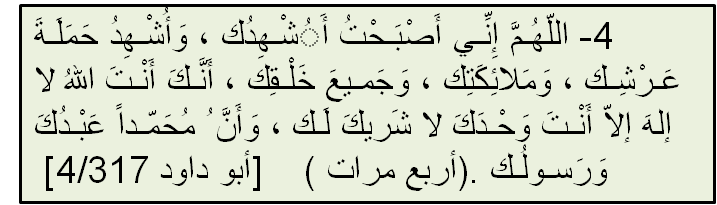
Allahumma inni asbahtu ush’hiduka wa ush’hidu hamalata ‘arshika wa malaikataka wa jami’a khalqika annaka Antallahu la ilaha illa Anta Wahdaka la shar?ka laka wa anna Muhammad-an ‘Abduka wa Rasuluk (4 times)
(Note: In the evenings, recite: amsaytu instead of asbahtu)
O Allah  ! As morning dawns upon me, I bear testimony before You and before the angels who carry Your Throne and all Your angels and all of Your creation that truly, You are Allah , there is no god but You, The One and Only God without any partner, and that truly, Muhammad is Your special devotee and Your Prophetic Messenger.
Allahumma inni asbahtu ush-hiduka. . .
Abu Daud narrated that Anas bin Malik said that the Prophet (pbuh) said:
“When one says, Allahumma inni asbahtu ushhiduka, wa ushhidu hamamalata ‘arshika… (until the end of the dua), Allah
Whoever recites it every day three times in the morning and in the evening, then he dies on the religion of Islam without a doubt, his tasbih is subhanaddaimi qaimi subhanad qaimi daimi subhanalhaiyul qaiyum subhanallahi wabihamdih subhanallahil azimi wabihamdih subhanal malikul qudus subhana rabbil malaikati warruhPrayer of Congratulations Crossing the Sirath BridgeWhoever reads Ashhadu an la ilaha illallahu wahdaha la syarika lahu ilahan wahidan, wa rabban shahidan, la ma'buda shiwahu, wa nahnu lahu
muslimun
after praying five times then the titian siratulmustaqim becomes four cubits.
Ablution prayer
Whoever recites this prayer after performing ablution, all his sins will be removed from all his limbs and the reward of his ablution will be stamped with a stamp that he will not die in a state of apostasy. In other words, he will die in faith, and his ablution will be lifted to heaven and the ablution will always be glorified. and meditate and write for him his reward until the Day of Judgment.
ashadu an la ilaha illallah wahdahu la sharika lahu wa ash hadu an namuhammadan abduhu warasuluh subhanaka allahumma wabihamdika ashaduanlailahailla anta amiltu suan wazalamtunafsih astaqfiruka waatubuilaika faqfirli watubalaiya innatattawaburrahim allahummajaalminattawwabinwajaalminatmutatahirinwajaalniibadikasolihinwajaalnisaburanwasyakuranwajaalniazzikrika kasiranwasabihubukratanwaasilan
Prophet said:"Whoever says Subhan Allah wabihamdihi hundred times a day, all his sins will be forgiven his sins even if much foam in the ocean." (Reported by Muslim and Tirmidhi) word of the Prophet that says: "Two words which are light on the tongue, heavy on the scales and loved by God, Most Gracious are: subhanallahi wa bihamdih, SubhanAllahil-`Azim " (Hadith Bukhari & Muslim)"From Abu Hurairah, the Prophet said: Renew your faith. They said: O Messenger of Allah, how we renew our faith? He said: Increase recite the words La ilaha illa Allah. (Reported by Ahmad, at-Tabarani and Targhib) ";word of narrated from the Prophet SAW said: "Anyone who reads three verses beginning of the letter al An'am the 40 thousand angels God delegated to note the good of their worship to him until the Day of Resurrection. And angels descend from heaven to seven armed with metal bars, when syaithon be teased so God ordered the angels to beat him, then between them and syaithon There are 70 forts. When Judgment Day has come and Allah Almighty's blessings and loving above says "walk in the branches, on that day there is no shade except naunganKu.Dan Surgaku eat fruits, drink from wells Kawthar and Salsabil bathe with water, then you are my slave and I your lordBismillaahir Rahmaanir RaheemAlhamdu lillaahil lazee khalaqas samaawaati wal arda wa ja'alaz zulumaati wannoor; summal lazeena kafaroo bi Rabbihim ya'diloonHuwal lazee khalaqakum min teenin summa qadaaa ajalanw wa ajalum musamman 'indahoo summa antum tamtarooWa Huwal laahu fissamaawaati wa fil ardi ya'lamu sirrakum wa jahrakum wa ya'lamu maa taksiboona benefit was narrated from the Prophet, peace be upon him, that he said: no one comes over a dead body that is too hard on the first night, so you have mercy on him with alms, then whoever does not earn it will get alms, so he should pray two rak'ats, read every rak'ah of surah al - fatihah once and ayatul kursi once and alhakumuttakasur once and qulhuwallahuahad ten times
pronounce the intention of prayer as a gift for the dead
Usalli sunattal hadiyati rakaataini lillahi taala
and this prayer is read after the salutation: Allahumma inni sollaitu hazihis solata waanta taqlamumayurid Allahumma ba as sawa biha illa qabri so-and-so nibni so-and-so then God Almighty resurrected from that moment to his grave a thousand angels and each one of them was a light that beckoned us in his grave until when the trumpet is blown, and God the Almighty bestows upon the person who prays that prayer with a number of things that the sun passes over it is virtue, and God the Almighty lifts him up forty thousand degrees, and he is blessed with an angel and the reward of a thousand martyrs is written for him, and God makes the Almighty for him is a thousand lands in heaven, and he is given clothes of a thousand ornaments, and he does not come out of the world until he sees his place in heaven with the mercy of God Almighty
Among the will and speech of the Prophet SAW to the public when he first arrived in Madinah is also the speech of the Prophet SAW:
أَيُّهَا النَّاسُ اَفْشوا السَّلَمَ, وَأَطْعِمُوا التَّعَامَ, وَسلوا الرحمَ وَسَلُوا بَلَّيلْ وَالنَّاُ ِيامٌ, تَدُلُوا جَنَّةَ بِسَلامٍ
It means: “Hey people. Spread greetings, give food, continue friendship and pray at night when people are sleeping, surely you will be able to enter Heaven in peace and safety."
History of Ibn Majah
a benefit was narrated from the Prophet, peace be upon him, that he said: no one comes over a dead body that is too hard on the first night, so you have mercy on him with alms, then whoever does not earn it will get alms, so he should pray two rak'ats, read every rak'ah of surah al - fatihah once and ayatul kursi once and alhakumuttakasur once and qulhuwallahuahad ten times pronounce the intention of prayer as a gift for the dead Usalli sunattal hadiyati rakaataini lillahi taala and this prayer is read after the salutation: Allahumma inni sollaitu hazihis solata waanta taqlamumayurid Allahumma ba as sawa biha illa qabri so-and-so nibni so-and-so then God Almighty resurrected from that moment to his grave a thousand angels and each one of them was a light that beckoned us in his grave until when the trumpet is blown, and God the Almighty bestows upon the person who prays that prayer with a number of things that the sun passes over it is virtue, and God the Almighty lifts him up forty thousand degrees, and he is blessed with an angel and the reward of a thousand martyrs is written for him, and God makes the Almighty for him is a thousand lands in heaven, and he is given clothes of a thousand ornaments, and he does not come out of the world until he sees his place in heaven with the mercy of God AlmightyAmong the will and speech of the Prophet SAW to the public when he first arrived in Madinah is also the speech of the Prophet SAW:أَيُّهَا النَّاسُ اَفْشوا السَّلَمَ, وَأَطْعِمُوا التَّعَامَ, وَسلوا الرحمَ وَسَلُوا بَلَّيلْ وَالنَّاُ ِيامٌ, تَدُلُوا جَنَّةَ بِسَلامٍ It means: “Hey people. Spread greetings, give food, continue friendship and pray at night when people are sleeping, surely you will be able to enter Heaven in peace and safety." History of Ibn Majah

Beautiful Islamic Nasheed la ilaha illallah Arabic With English Nasheed Tasbih - Duration: 6:12.
- Beautiful Islamic Nasheed la ilaha illallah Arabic With English Nasheed Tasbih.
- HD

Judika-Apakah Ini Cinta [Lirik Video]Already watched. - Duration: 3:43.
- HD

Nassier Wahab Kau Yang PertamaAlready watched. - Duration: 4:25.

Selembut Sutera - Nur fatimahAlready watched. - Duration: 5:00.